Mayor Mamdani released his executive budget, which adds $5 billion in new affordable housing capital funds (FY2026-2031). Mayor Mamdani campaigned on the promise of $10 billion in affordable housing investment, signaling a strong commitment to addressing the housing crisis in a meaningful way. While this budget does not reach that level of investment yet, compared to actual spending in FY2025, budget increases for the next two years are significant. Capital for new construction of affordable housing is more than double and preservation is increased about 20 percent.
Most of the new funding is allocated in the upcoming two fiscal years, which will give a huge boost to HPD’s pipeline and fully utilize the expanded federal Low Income Housing Tax Credits, while continuing NYCHA’s preservation programs.
That being said, in FY 2029, the City’s affordable housing production and public housing preservation will plummet unless additional capital is added to the plan. Mayor Mamdani’s housing plan is expected to be released later this month to provide more details on programmatic priorities and spending.
NYHC is encouraged by the additional housing capital added over the next two fiscal years, especially given the challenging budget environment. We urge the Administration to maintain at least this level of capital investment in the outyears for affordable and public housing to meet the supply shortage and urgent preservation needs. We look forward to the release of the Mayor’s housing plan and implementation of SPEED Task Force reforms which we expect to meaningfully save time and money in affordable housing development.
Housing Capital Budget
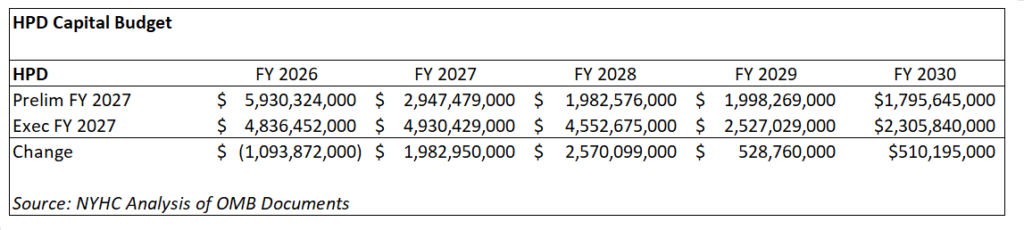
The mayor’s executive five-year capital budget (page 181) for HPD totals $19.2 billion. The capital budget is reduced in the current fiscal year by $1.1 billion and then increased by nearly $2 billion next year (FY 2027) to $4.9 billion and increased by $2.6 billion in FY 2028 to $4.6 billion, which includes $500 million for NYCHA preservation programs. In FY 2029 and 2030, the HPD capital budget increased by $500 million in each year, but the budget for those years is only $2.5 billion and $2.3 billion, respectively. The mayor’s budget summary also says they added $500 million in housing capital in 2031, which is not specified in the capital commitment charts.
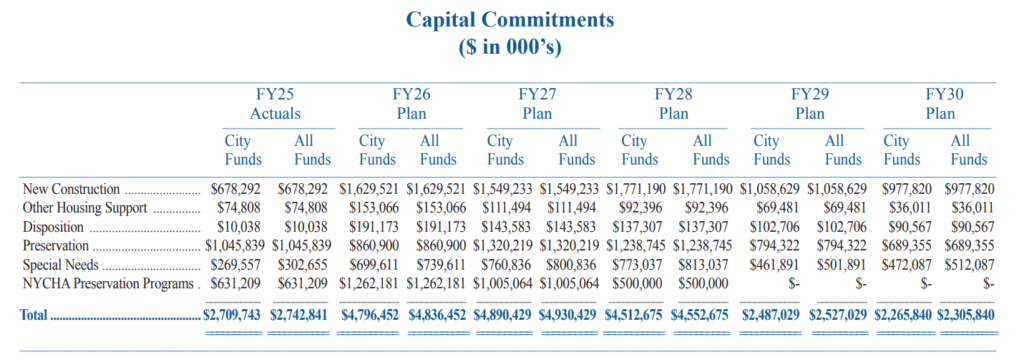
The additional spending is spread through new construction, special needs housing, and preservation, and NYCHA preservation programs. Total capital funding for new construction will be $1.5 billion next year and $1.8 billion in FY 2028 while special needs housing funding will be $800 million next year and $813 million in FY 2028. Preservation funding will be $1.3 billion next year and $1.2 billion in FY 2028. NYCHA preservation programs funding will be $1 billion next year and $500 million in FY 2028. There is no funding for NYCHA preservation programs beyond FY 2028.
The following OMB chart breaks down housing capital spending across HPD’s program areas.
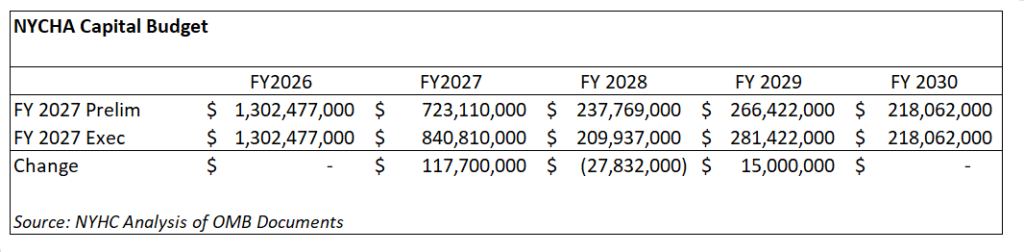
City capital funding for NYCHA repairs and comprehensive modernization increased by $100 million over the five year plan, growing to $840 million next year but remaining at between $200 and $300 million over the next three years.
Housing Expense Budget
On the expense budget, HPD is proposing savings but also seeing increased funding to meet new needs. In savings, HPD is projecting savings of roughly $5.8 million per year on average over five years through cost re-estimates, streamlining, bulk purchasing, reduced costs, funding swaps and vacancy reductions. Most of the savings – more than $4 million per year – comes from cutting 56 vacant positions from the budget.
On the other hand, HPD’s expense budget increased to support new needs, adding: $1.2 million per year to support basement initiatives, $2.5 million per year for code enforcement expansion, $2.4 million for the TIL program and up to $3 million per year for the Mortgage Assistance Program. In addition, the budget reflects new needs to support the SPEED Task Force recommendations including, $1.9 million per year for additional development staff, $187,000 per year for additional environmental review staff, $540,000 per year for permitting and approval staff.
Taken together – the cuts to vacant staffing and the new staffing added for specific initiatives, HPD’s budgeted staffing is largely the same as it was in the previous budget –2,870 next year compared to 2,881 in the budget plan from February.
In addition, HPD is providing $75.9 million in total new expense funding over five years for NYCHA programs including elevators, mold and leaks remediation, ombudsman call center, and vacant unit readiness.
City Planning Expense Budget
The Department of City Planning also saw budget savings and new proposed spending. The agency is projecting spending $1.1 million less this year and $300,000 less each year over the next two years on Environmental Impact Statements and their budgeted staffing is reduced by 3 positions and between $200,000 and $300,000 to cut vacant positions. But the agency’s budget increased by $2.9 million next year and $1.8 million in future years for the City Map Amendment, by $1.5 million the next two years and $3.9 million in future years to add rezoning capacity and $2.1 million next year and $1.3 million in future years to support the SPEED Task Force recommendations.
DSS Expense Budget
Housing-related budget items at the Department of Social Services similarly saw savings as well as money for new needs. They projects that they will save $235 million per year over the next four years by containing cost growth in the CityFHEPS program. In the budget summary the mayor said they need to, “ensure CityFHEPS is fiscally sound and sustainable for the long-term.” The summary said they will find savings by curbing expenditure growth by centralizing support functions, strengthening oversight and implementing administrative reform and that they would help current voucher holders increase incomes and reduce long-term usage of CityFHEPS.
The city is also projecting savings in shelter costs by optimizing prevention and housing relocation tools to move people from shelter into housing and prevent people from entering shelter and seeking efficiencies in the shelter budget and reducing reliance on emergency hotels. They are projecting to save $284 million next year and between $23 million and $74 million in future years. They are also projecting savings of $7.2 million per year through reducing 183 vacant staffing positions.
At the same time, the administration is adding $11.4 million next year and roughly $16 million in the outyears for cash assistance staffing, $17 million for domestic violence shelters, $25 million next year and $44 million in the future years for Right to Counsel, and $3.4 million next year and $4 million in future years for the SARA (Senior Affordable Rental Apartments) program.