NYC Mayor Zohran Mamdani recently released his housing plan – Block by Block. The plan includes strategies for empowering tenants and strengthening code enforcement, preserving existing affordable and public housing, building new affordable and market-rate housing, expanding homeownership, and reducing and preventing homelessness.
“NYHC congratulates the Mamdani Housing Team for putting together a thoughtful vision for building and preserving the affordable housing New Yorkers need. This plan centers the renters being crushed by housing costs and builds on proven strategies to add supply and preserve existing affordable housing. We look forward to supporting implementation of this housing plan to make NYC more affordable for all of its residents.”
Earlier this month, Mayor Mamdani released his executive budget, which includes the funding to support his housing plan. The plan added $5 billion in new affordable housing capital funds (FY2026-2031).
Most of the new funding is allocated in the upcoming two fiscal years, which will give a boost to HPD’s pipeline and fully utilize the expanded federal Low Income Housing Tax Credits, while continuing NYCHA’s preservation programs. Funding for new construction is $1.5 billion and $1.8 billion in the next two years and HPD preservation funding is $1.3 billion and $1.2 billion. Total city capital funding for housing – HPD and NYCHA – over the next five years is $22 billion, roughly $4.4 billion per year. Capital funding drops starting in FY2029 for HPD and NYCHA.
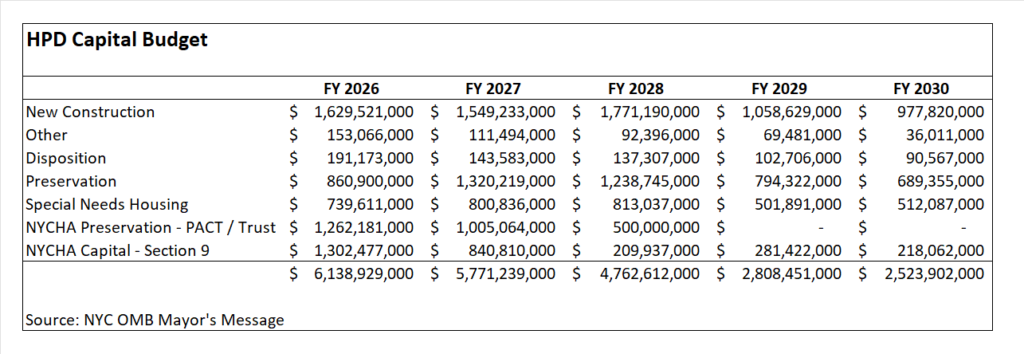
Overall, the plan promises to build 200,000 units of new affordable housing and preserve 200,000 units of affordable housing. However, additional funding will be required after FY2028 to achieve this level of affordable housing production and public housing preservation. A strong market response will also be required to increase affordable production through tax and zoning incentives to meet these targets.
Below are highlights of the plan, which you can find here.
- Empowering tenants and strengthening enforcement: strengthening code enforcement through targeted efforts, updating the housing maintenance code, reducing eviction cases while supporting tenants in housing court who are facing unsafe conditions, and supporting tenant organizing.
- Preserving affordability and improving housing quality: lower operating costs through city-backed insurance and expanded water affordability, evaluating property taxes on stabilized buildings, expanding HPD preservation programs including supporting Mitchell Lama projects, launching new preservation tools including access to pooled reserves and new supportive housing preservation, and revamping the Third Party Transfer program and supporting the Community Opportunity to Purchase legislation. The plan says these initiatives will preserve and stabilize 200,000 units of affordable and public housing over the next 10 years. Over the past five years the city has preserved an average of nearly 13,000 units while the PACT program has preserved nearly 4,000 units per year on average over the past five years. The executive budget allocated nearly $5 billion in capital over five years for HPD’s preservation programs and $2.7 billion for NYCHA’s PACT and Trust programs.
- Securing NYCHA’s future: The plan proposes to fix leaks and address mold, improve elevator performance, support NYCHA resident engagement, accelerate NYCHA vacant units’ readiness, making repairs, and exploring new models of affordable housing development on NYCHA. The plan notes that NYCHA is already planning to preserve 62,000 units through PACT, 25,000 units through the Preservation Trust and Comp Mod is described as “not a scalable alternative to PACT or the Trust for delivering capital investment without a significant infusion of additional federal funding”. NYCHA has 177,000 total apartments and 25% (roughly 44,600 units) have already been renovated. The Mayor’s budget proposed $5.6 billion for NYCHA over five years, including $2.8 billion for PACT and $2.8 billion for conventional public housing.
- Building neighborhoods for working people: The plan commits to a path to build 200,000 new affordable units over the next 10 years, including roughly 8,000 HPD/HDC subsidized units per year. 12,000 units would need to be generated annually through other incentive or financing programs. Over the past five years, the city has produced roughly 13,000 affordable units per year on average, including subsidized units and affordable housing required through 421a and inclusionary housing programs. The plan commits to creating new financing tools, including new mixed-income tools. The plan promises 1,000 units of senior housing per year over the next two years, and to expand housing for justice involved people. The mayor said he will seek ambitious zoning and planning actions to add housing citywide, including Transit-Oriented Development and city-sponsored rezonings.
- Expanding and stabilizing homeownership: doubling new construction of affordable homeownership housing through the Open Doors program, creating new affordable co-ops, supporting Community Land Trusts, supporting basement legalization and Accessory Dwelling Units, expanding downpayment assistance, and supporting existing homeowners with mortgage assistance program, deed theft prevention, and repairs through the HomeFix program.
- Reduce and prevent homelessness: expand right to counsel funding, explore ways to strengthen HomeBase homelessness prevention program, support programs that move people from homelessness to housing, strengthen shelters and expand specialized programs for people with complex needs.
- Investing in strong jobs and innovation: implement the Construction Justice Act, explore potential for Project Labor Agreements in city-financed affordable housing projects, support construction safety, and reform building codes.
- Achieving public excellence: implement SPEED task force, accelerate vacant unit readiness at NYCHA, reduce vacancies in supportive housing, and invest in technology to connect New Yorkers to housing.
NYHC Preservation Priorities
NYHC has been advocating for policy solutions to increase revenue and lower operating costs in many affordable housing buildings running operating deficits. The plan partially addresses our recommendations.
Eviction Prevention & Diversion: The plan references, “new proposals that would connect tenants and owners of affordable and supportive housing to financial assistance more efficiently” and reduces rent burden for ELI households from the standard 30% to 25%.
We recommended both of these policy changes in our recent report on evictions in affordable housing. We are thrilled that the Administration is adopting these policy changes and we look forward to learning more details about implementation.
WSJ and Crain’s NY reported that the City will create a $5 million “fund to cover rent arrears and avoid evictions”.
In 2024, the total amount of arrears sought at initial eviction filings in subsidized housing was $175M. That amount grows during the court process. NYHC strongly supports efforts to address rent arrears outside of a court process.
Insurance: The City is “investing $100 million to back a new, lower-cost insurance program. The City expects to launch the new program in 2027 with approximately 20,000 regulated homes, expanding to 100,000 homes in 2030.”
We are extremely supportive of a publicly-backed insurance program and believe it can significantly reduce costs for buildings able to participate.
Multi-family Water Assistance Program: This program which now serves 48,000 units will be expanded to serve 75,000 low-income households.
With UNHP, we called for an increase in the per unit benefit and for the program to expand to cover all affordable housing. Given the recent multi-year rate increases, this expansion doesn’t go far enough. Most affordable housing buildings will likely see a 6% increase in water rates without access to this program.
Rent Restructuring: WSJ and Crain’s NY reported on rent restructuring under “Targeted Owner Options for Long-term Stability” (TOOLS) to stabilize and fortify the financial health of affordable housing, although the housing plan does not specify changes to the City’s current policy. HPD can already restructure rents when utilizing their loan authorities under Article 8 and Article 15 of New York State Private Housing Finance Law. HDC can more easily offer rent restructuring to projects in their portfolio without lending. NYHC had been advocating for state legislation for affordable units under regulatory agreement to automatically avail of current year AMI at vacancy to help correct operating deficits, but this proposal has not advanced.
We look forward to additional details from the City on TOOLS.