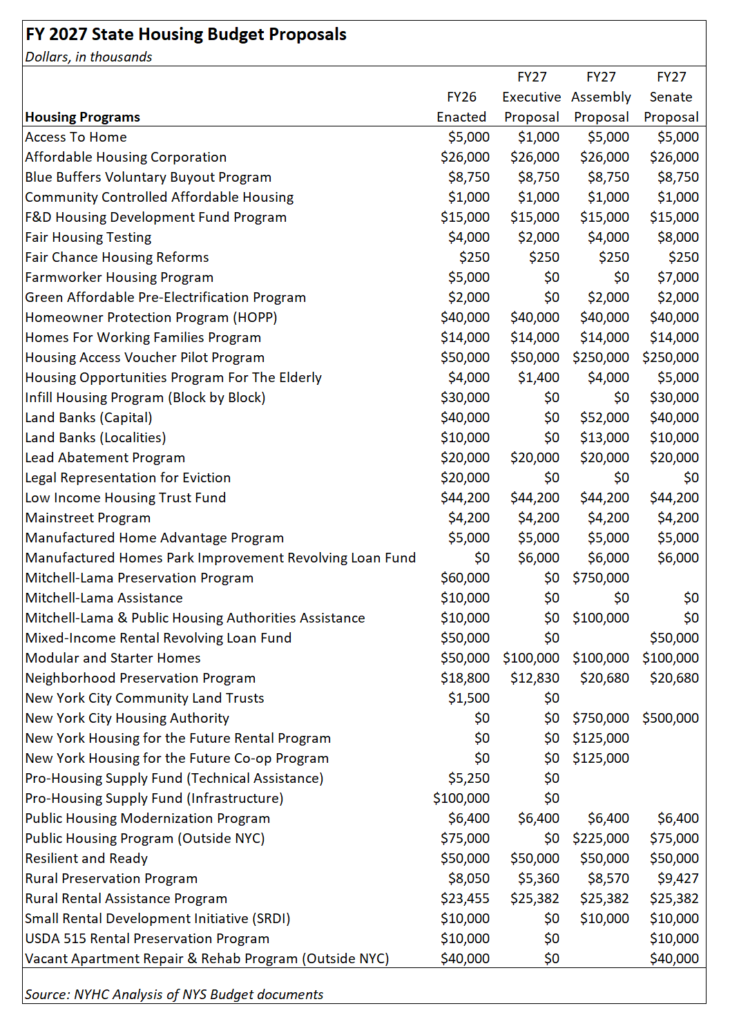
The State Senate and Assembly each released their one-house budget proposals last week. Our top priority for Albany this year is addressing the alarming share of affordable and supportive housing buildings that are in financial distress. When these buildings are at risk of financial instability, it threatens the very foundation that makes these buildings affordable, putting their tenants at risk. While the Senate provided some funding towards this need, there has not been a proposal from the Legislature or Governor that would address the issue at scale.
We are glad to see robust funding for existing housing programs in both chambers, including for NYCHA and Mitchell-Lamas. Both the Senate and Assembly also included the governor’s proposed $250 million to accelerate and expand affordable housing supply and $250 million for the Housing Access Voucher Program (HAVP).
Distressed Affordable Housing
NYHC and partners have called on the state to provide support for distressed affordable housing. We called for $250 million for an Affordable Housing Relief Fund to help stabilize distressed properties that are facing rising insurance, staffing and maintenance costs and nonpayment of rent. In addition, NYHC proposed $17M for a new Affordable Housing Stability Court Initiative.
The Senate included $40 million for an Affordable Housing Relief Fund ($20 million in NYC and $20 million for the rest of the state) and their budget resolution included language that said, “The Senate recognizes the need for swift and sound resolutions of matters being heard in housing court and supports the efforts of the Office of Court Administration to operate special parts in New York City’s housing courts to adjudicate eviction cases.”
The Assembly did not include any funding for distressed affordable housing.
NYHC is glad to see some funding to support distressed affordable housing in the Senate, but the need is much greater. We urge the Legislature and the Governor to prioritize this issue in the budget with solutions to stabilize distressed affordable housing.
We also appreciate the Senate language in support of eviction diversion and that a standalone bill has been introduced to create the special court part by Senate Housing Chair Brian Kavanagh and Senate Judiciary Chair Luis Sepulveda (see below). We remain hopeful that an eviction diversion program will be funded in the budget.
SEQRA Reform
The Senate modified the Governor’s reform proposal for the State Environmental Quality Review Act (SEQRA) by limiting the SEQRA exemptions to only infill multifamily housing projects (4+ units), with no more than 20% for commercial or community use, particularly in urban areas, conditioned on the project fulfilling minimum environmental and infrastructure standards and scaling the size of developments exempted to community context. Notably in NYC the number of units is increased to under 1,000 and areas out of NYC are further categorized. In cities, towns and villages with more than ninety thousand people but fewer than 1 million, projects must have fewer than 500 units, and up to ninety thousand, fewer than 200 units. It further provides for fewer than 50 units for buildings not connected to existing water and sewage and fewer than 10 units in municipalities that don’t have zoning regulations. The bill also provides language for the relevant agency to ensure projects do not create significant levels of pollution or displace low-income residents. This proposal is similar to S.3492-A.
The governor’s proposal would exempt projects: in New York City if they have a maximum of 250 units or 500 units in medium and high-density areas, with a maximum of 50,000 square feet of non-residential if it’s mixed use, and are outside of flood zones and areas zoned exclusively for industrial purposes; outside New York City if it is maximum of 100 units, connected to existing water and sewage systems and located on a previously undisturbed site and a maximum of 50,000 square feet of non-residential or 20%, whichever is less.
The Assembly did not include language on SEQRA reform, following their practice of not including policy in their one-house budget proposals.
NYHC strongly supports SEQRA reform and we believe changing this outdated law used to block housing will greatly benefit housing supply across the state.
Affordable Housing Production
Both the Senate and Assembly included the Governor’s proposal for $250 million to accelerate and expand affordable housing development this year for the five-year housing plan.
NYHC is pleased to see the Senate and Assembly support this capital infusion to take full advantage of LIHTC expansion unlocked by lowering the LIHTC 50% test and the increased 9% allocation.
Affordable Independent Senior Housing Assistance Program
The Senate includes $2 million for a new Affordable Independent Senior Housing Assistance Program to provide support for residents of affordable independent senior housing (occupied by individuals over 60, and at least 80% at 60% AMI or under) to promote healthy living and improve quality of life.
NYHC strongly supports this program and urges leadership to include it in the final budget to allow residents to age with dignity independently.
Housing Access Voucher Program
Both the Senate and the Assembly included $250 million for HAVP. The governor’s proposal included $50 million for the program, the same amount allocated last year for the first time.
NYHC supports expanding HAVP to $250 million to support households in shelter or at risk of becoming homeless.
New York City Housing Authority (NYCHA)
The Assembly provides $750 million and the Senate provides $500 million in capital for NYCHA. The Assembly also provides another $100 million for Mitchell Lama and NYCHA support for operating and maintenance needs.
NYHC supports annual State funding for NYCHA to improve living conditions for its residents.
J-51 Renewal
The J-51 program is set to expire at the end of June. The Senate modified the governor’s proposal to extend and reform the existing J-51 tax abatement by increasing eligibility for rent-regulated housing, increasing the assessed value eligibility threshold for condominiums and cooperatives, increasing the frequency for updates to the cost schedule, and capping and making refundable the program application fee (S.8170-A).
NYHC supports renewing and modernizing J-51, an important preservation tool.
SCRIE / DRIE
The Senate modified the governor’s proposal to raise the income threshold for the Senior Citizen Rent Increase Exemption (SCRIE) and the Disability Rent Increase Exemption (DRIE) by including the Senior Citizen Homeowners’ Exemption (SCHE), and Disabled Homeowners’ Exemption (DHE), requiring the maximum income threshold reflect any rise in inflation (the consumer price index), and requiring notice to residents regarding eligibility.
The Assembly’s did not include extending the SCRIE and DRIE programs for an additional two years and increase their income eligibility thresholds. The Assembly said they support, “efforts to ensure that programs, such as SCRIE and DRIE, continue to provide crucial benefits to seniors and people with disabilities as housing costs continue to increase.”
NYHC strongly supports expanding programs to prevent housing burden among older adults. About 60,000 older adults live in rent stabilized housing in NYC and almost half are rent burdened, with 33 percent paying more than half their income in rent.
Insurance
The Senate modified the Governor’s proposed insurance changes. The Senate bill would require auto, homeowners’ and residential property insurers to provide written explanations for premium increases over 10% for every increase. The Senate proposal would also require large homeowners’ insurers to resubmit rates for approval if their actual loss ratios over a two-year period fall below a DFS-established benchmark by requiring the benchmark to account for both actual loss ratios and investment returns over three years. The Senate requirement for automatic property insurance premium reductions for risk mitigation measures would also include requiring: actuarially appropriate premium reductions based on demonstrated property-specific mitigation actions, public insurer disclosure of information on available discounts, and allowing policyholders to appeal mitigation discount determinations. Also, the Senate said they were open to discussing additional reporting requirements, above the Governor’s proposal to require annual reporting to DFS for residential properties with two or more units, to gain insight into trends in premiums, claims, and coverage availability in the multifamily residential insurance market.
The Assembly did not include the insurance reforms proposed by the governor in the executive budget. Instead, they included language that said, “The Assembly is committed to addressing the rising costs of home and auto insurance throughout New York State and supports meaningful changes in this area to help reduce such costs for consumers. The Assembly will continue to explore solutions that help reduce fraud, lower rates, and increase transparency for policyholders.”
NYHC supports efforts to bring more transparency to both the commercial property and homeowners insurance markets and will continue to advocate for stronger policies to bring down costs.
Supportive Housing
The Assembly proposed Homeless Housing Assistance Program (HHAP) funding, which supports construction and preservation of supportive housing, at $153 million while the Senate proposed an addtional $100 million – totaling $253 million.
We appreciate the Senate’s proposed increase and we support the Network’s call for a continuation of the $25 million set-aside for supportive housing stabilization and a doubling of the $128 million available for the main funding program, for a total of $281 million.
First Home Savings Program (S.1157)
The Senate proposes a new tax-advantaged savings accounts for first-time home buyers to cover expenses toward the purchase or construction of a house, townhouse, condo or co-op.
Mobile and Manufactured Home Replacement Program (S.2721)
The Senate proposes a new program to provide grants to eligible property owners to replace dilapidated mobile or manufactured homes.
Jobs and Housing Pilot Program
The Senate provides $25 million for a new program to provide capital funding for affordable and workforce housing construction and preservation projects that promote apprenticeship programs, commit to wage standards, and utilize labor organization pension financing. This language is similar to S.2523.
Additional Housing Funding
The Senate and Assembly both proposed additional housing funding. The Senate proposed $30 million for an infill housing program, $40 million for land banks, $50 million for a mixed-income rental revolving loan fund to develop mixed-income housing outside of NYC, $75 million for public housing, $100 million for Mitchell Lama preservation ($60 million in NYC and $40 million for the rest of the state), $40 million for statewide senior housing program, $30 million for supportive housing for formerly incarcerated individuals and $5 million for Senior Homeowner Foreclosure Arrears Assistance.
The Assembly has proposed $52 million for land banks, $750 million for Mitchell Lama preservation, $125 million each for the NY Housing for the Future rental and co-op programs, $225 million for public housing authorities outside NYC for rehab and new construction, and $50 million for first time homeowner assistance for downpayment assistance.