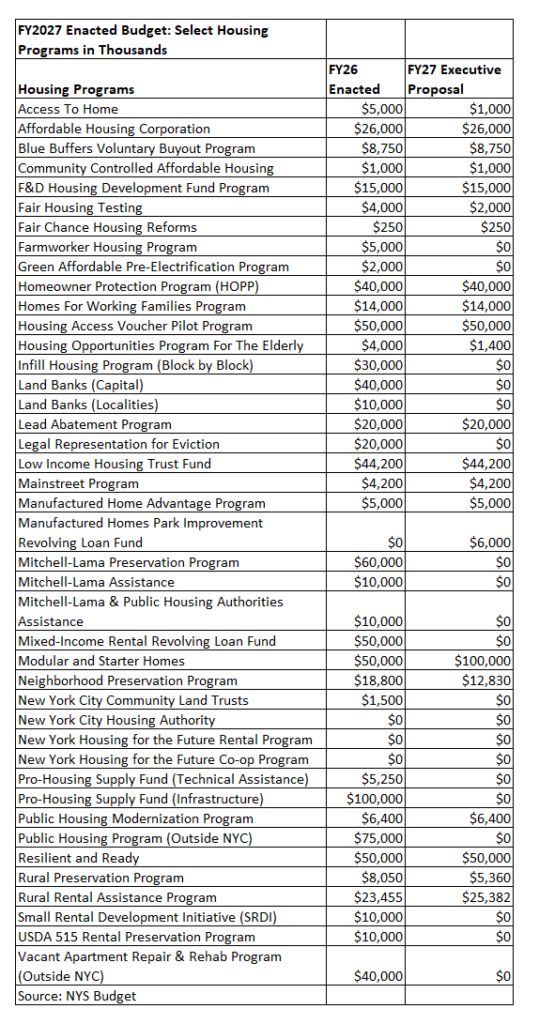
Last week, Governor Hochul released an Executive Budget to support housing supply, including reforms to the State Environmental Quality Review Act (SEQRA), proposals to begin to address rising property insurance costs and provide support for rent stabilized tenants. We applaud the Governor’s continued efforts to expand housing supply statewide and pursue regulatory reforms that would reduce barriers to building affordable housing in every community.
In addition to supporting much of the Executive Budget proposals for housing, New York Housing Conference will advocate for $250 million for the Housing Access Voucher Program (HAVP), which was passed in last year’s budget as a 4-year pilot program funded at $50 million per year. We are also working on additional proposals to address distressed affordable housing with more to share in upcoming weeks when we release our 2026 policy priorities.
Here are housing highlights in the executive budget bills:
Supporting Housing Supply
$250 Million Capital Infusion (Capital)
To accelerate and expand affordable housing development this year, the Governor proposed an additional $250 million in supplemental capital funding for the five-year housing plan citing recent changes to Federal Low Income Housing Tax Credits.
NYHC is pleased to see this capital infusion to take full advantage of LIHTC expansion unlocked by lowering the LIHTC 50% test and the increased 9% allocation.
State Environmental Quality Review Act Reform (TED Part R)
The Governor proposed multiple amendments to the State Environmental Quality Review Act (SEQRA) to accelerate certain projects and streamline the environmental review process.
NYHC strongly supports modernizing SEQRA to make it easier to build the projects that will help lower the cost of housing and utilities while maintaining strong environmental standards and addressing our changing climate.
Exempt Certain Housing & Infrastructure Projects
The bill lays out criteria to exempt certain housing projects from the state’s SEQRA process if they do not have a significant environmental impact. It would not modify or affect authorizations, requirements, or procedures regarding historic preservation under State and Federal law, or other non-SEQRA review or regulation at the State and local levels.
In New York City projects would be exempt if they are outside of flood zones and areas zoned exclusively for industrial purposes and meet the following criteria:
- If mixed-use, have a maximum of 50,000 sqft of non-residential use
- Maximum of 250 units total, or 500 units if in medium or high-density areas
Outside of NYC, projects must:
- Be connected to existing water and sewage systems
- Be located on a previously disturbed site
- “previously disturbed site” must meet all of the following requirements:
- Has been developed 2 years before the application before the application for a permit or authorization for an action
- Is substantially altered by one or more of the following uses or combination thereof, whether currently in use, abandoned, or demolished: buildings or structures, impervious surfaces, maintained lawns or other non-vegetated maintained areas, or public infrastructure utilities;
- Is not located in a flood zone and
- Has not been used for agricultural purposes within three of the last five years before the application for a permit or authorization for an action.
- “previously disturbed site” must meet all of the following requirements:
- If mixed-use have a maximum of the lesser of 50,000 sqft of non-residential use or 20 percent
- Maximum of 100 units total
Exempt certain projects on previously disturbed land such as:
- Public parks
- Multi-use bicycle and pedestrian trails
- Childcare facilities connected to existing water and sewage
Exempt certain water and wastewater projects that:
- Replace, rehab or reconstruct municipal water or wastewater infrastructure or a small community water system
- Provide sewer service to a disadvantaged community
- Retrofit existing structures to incorporate green infrastructure
Set Maximum Time Period for EIS Completion
Requires agencies to determine whether a SEQRA environmental impact statement (EIS) is required within one year and requires the EIS to be produced with two years of this determination, though allows the agency to extend the deadline under certain circumstances.
Activating Underutilized Sites (Freestanding Concurrent Resolution)
Allows for the sale of three former correctional facilities – Camp Gabriels in Franklin County, Moriah Shock in Essex County, and Mount McGregor in Saratoga County for public benefit such as housing, economic development and environmental benefits. The state would also have to acquire at least 1,500 acres of land for inclusion in the forest preserve that is determined to be of equal or lesser value by the legislature. As a constitutional amendment, this would need to pass in two consecutive sessions.
Increase Number of Land Banks (ELFA Part N)
Increases the cap on the number of land banks permitted in New York from 35 to 45. Land banks are a critical tool for communities to address vacant, deteriorating and abandoned properties and use them for affordable housing.
Manufactured Homes Park Improvement Revolving Loan Fund (Aid to Localities)
$6 million for a new revolving loan fund to finance improvements to critical infrastructure and upgrades for residents in manufactured home parks.
Smart Growth Water Grant Program (Capital)
$200 million to support water infrastructure projects necessary to promote housing preservation and development in regions throughout the state.
Addressing Rising Insurance Costs
Reporting Requirements for Insurers of Multi-Family Housing (TED Part GG)
Requires annual reporting from insurers of multi-family housing (2+ units) that includes information on the premiums collected, claims paid and other information determined by DFS in consultation with HCR, which will be published on the DFS website.
Automatic Property Insurance Premium Reductions (TED Part DD)
Requires insurers to offer discounted premium rates to homeowners and commercial property owners who make improvements to their property that contribute to the safety and security. It also requires the available discounts to be clearly communicated in the policy.
Actuarily appropriate reductions in commercial property and homeowners’ insurance premiums, including property insurance premiums for public entities, would be available to owners who take on mitigation efforts. DFS would determine the criteria for at least one discount to be available in each of the following categories:
- Fire insurance or fire insurance component ie. smoke alarms, sprinklers & extinguishers
- Theft prevention ie. dead bolt locks or security systems
- Water damage ie. Smart water monitor and shutoff device
- Roof integrity ie. roof construction or replacement
- For each wind damage mitigation measure:
- Improvements to roof coverings for wind resistance
- Roof deck attachments
- Secondary water resistance
- Roof to wall connections
- *For commercial property insurance only: Hurricane resistance laminated glass windows or doors.
All improvements would be required to be certified and constructed in accordance with all local and State building codes to qualify for premium reductions.
Premium Increase Explanations for Home & Car Owners (TED Part BB)
Requires homeowners and automobile insurers to notify policy holders of the amount of any premium increases over 10 percent and the primary contributing factors in advance of renewal. It also requires insurers to inform consumers of their right to request a written explanation for any premium increase and they must respond to within 20 days of receiving a request.
Homeowners’ Insurance Benchmark Loss Ratio (TED Part CC)
Requires DFS to conduct a study to determine a benchmark loss ratio for homeowners’ insurance. Insurers with average annual gross premiums of at least $10 million and loss ratios below the benchmark for two years in a row would be required to refile rates for approval.
New York Housing Conference supports efforts to bring more transparency to both the commercial property and homeowners insurance markets. If passed in the final budget, NYHC will engage with our partners to share programmatic recommendations with DFS.
Supporting Tenants
Expanding SCRIE & DRIE (Revenue – Part V)
Expands the income eligibility thresholds from $50,000 to $75,000 in New York City for the Senior Citizen Rent Increase Exemption (“SCRIE”), and the Disability Rent Increase Exemption (“DRIE”) programs for two years, until June 30, 2028 and allows localities outside NYC to opt-in. SCRIE and DRIE freeze rents for seniors and people with disabilities in rent stabilized and Mitchell-Lama housing through property tax credits.
NYHC strongly supports expanding these rent freeze programs. About 60,000 older adults live in rent stabilized housing in NYC and almost half are rent burdened, with 33 percent paying more than half their income in rent.
Mitigating Energy Cost Burden (TED Part P)
Requires gas and electric companies to submit an annual energy affordability index annually – methodology to be determined by the Public Service Commission (PSC) – on the existing energy burden upon their residential customers. They would also need to provide this information when filing an application for a major change in rates.
The PSC would be required to submit a report on energy affordability in New York State compared to other states. For any companies that exceed an energy burden of 3% for residential electric or gas, the PSC would be empowered to install an independent affordability monitor inside the utility, paid for by the utility. The monitor would have full access to meetings, records, accounts, books, documents, contracts, and papers necessary to review utility operations and expenditures. The affordability monitor shall report the primary cost drivers that caused the energy burden to exceed 3% and identify any opportunities for cost savings to the PSC.
Protecting Tenants from Unfair Utility Shutoffs (TED – Part Q)
Removes current provisions that allow utility companies to shut off services to an entire multiple-dwelling building (3+ units) due to nonpayment by the landlord. Instead, they would be able to seek a lien against the building owner for the amount of the unpaid bills, preserving essential services for tenants.
Enhance Penalties For Harassment of Rent-Regulated Tenants (ELFA – Part P) Creates a new Class D felony offense of aggravated harassment of a rent regulated tenant. An owner would be guilty of aggravated harassment of a rent-regulated tenant when the owner either engages in a systematic ongoing course of conduct with the intention to induce two or more rent-regulated tenants to vacate apartments in two or more residential buildings, or commits harassment in the first degree twice in five years. The bill also clarifies that the pursuit of lawful evictions should not be considered systemic harassment.
Reform J-51 (ELFA – Part O)
Makes a number of reforms to J-51 and authorizes the program for ten years. J-51 provides eligible residential building owners with property tax abatements for rehabilitation. It would increase the tax abatement for eligible rental and owner-occupied buildings in NYC from 70 percent to 100 percent of the certified reasonable costs of alterations and improvements. The abatement would be for up to 20 years and would be available for eligible preservation work completed after June 30, 2026, and before June 30, 2036. The certified cost schedule would be created by HPD and would need to be updated every three years.
Eligible buildings include
- Rental housing that is
- At least 50 percent affordable, or
- Mitchell-Lama rental housing, or
- Government-subsidized
- Regulated homeownership housing operated by mutual companies or mutual redevelopment companies
- Co-ops and condos with an average assessed valuation of $60,000 or less per unit – an increase from the previous cap of $45,000.
We support J-51 renewal – an important preservation tool – and we are evaluating program modifications.
Funding for Existing Housing Programs
NYHC opposes decreased funding levels for housing programs such as the Neighborhood and Rural Preservation Programs and the Small Rental Development Initiative which the Executive proposes to cut. We expect the Legislature will advocate for full restoration, as they have in past years.
Other programs that have not been funded in the Executive budget such as NYCHA, Mitchell-Lamas and Housing for the Future, received dedicated funding from the $1 billion in capital allocated last year to support City of Yes, which we expect to be allocated over five years.